Web Services Message Routers
Message routers direct data from a requesting resource to a responding resource and back. These are also known as data routers, application brokers, or message brokers.
Message routers are a way to reduce complexity. When there is a need to exchange messages or data among internal systems, the number of possible interations can become complex. This is illustrated in the figure below where each internal system needs to exchange messages or data with all the other internal systems.
A message router simplifies the system architecture by being able to route messages and data to the correct internal system. This reduces the number of interconnections in the systems architecture as illustrated in the following figure.
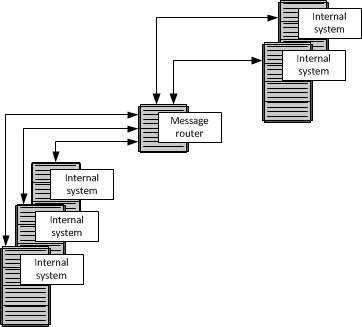
Existing internal systems will most likely also need an adapter. See Web Services Adapters.
More information on Web Services message routers can be found in Web Services, Service-Oriented Architectures, and Cloud Computing: The Savvy Manager's Guide.
Context for Web Services Message Routers
Related Articles for Web Services Message Routers

Author
Douglas K Barry
Principal
You may use this material for your work or classes. Reprint Policy. Be sure to check the menu at the left for other articles available on this site.
The Savvy Manager's Guide
Douglas K Barry is also the author of a book that explains Web Services, service-oriented architecture, and Cloud Computing in an easy-to-understand, non-technical manner.
Web Services, Service-Oriented Architectures, and Cloud Computing: The Savvy Manager's Guide (Second Edition)
by Douglas K Barry with David Dick
This is a guide for the savvy manager who wants to capitalize on the wave of change that is occurring with Web Services, service-oriented architecture, and—more recently—Cloud Computing. The changes wrought by these technologies will require both a basic grasp of the technologies and an effective way to deal with how these changes will affect the people who build and use the systems in our organizations. This book covers both issues. Managers at all levels of all organizations must be aware of both the changes that we are now seeing and ways to deal with issues created by those changes.