Web Services Interoperability Organization (WS-I)
Web Services Interoperability Organization (WS-I) was an open, industry organization chartered to promote Web Services interoperability across platforms, operating systems, and programming languages. The organization worked across the industry and standards organizations to respond to customer needs by providing guidance, best practices, and resources for developing Web Services solutions. On July 22, 2010, the WS-I announced its decision to transition its assets, operations, and mission into a Member Section of OASIS (Organization for the Advancement of Structured Information Standards).
WS-I provided supporting implementation guidance and testing resources for each of the Profiles it developed. The organization’s deliverables were targeted at proving resources for any Web Services developer to create interoperable Web Services, and verify that their results are compliant with both industry standards and WS-I recommended guidelines.
- Profiles: Sets of Web Services specifications that work together to support specific types of solutions. The first profile was the WS-I Basic Profile. This profile included XML Schema, SOAP, WSDL, and UDDI. See Profile Documentation.
- Profile Testing Tools: The WS-I testing tools were designed to help developers determine whether their Web Services are conformant with Profile Guidelines. See Testing Tools.
- Sample Applications: With the context of a profile, the teams worked to define a set of Web Services that were implemented by multiple team members to identify where interoperability issues are present. See Sample Applications.
On July 15, 2008, WS-I announced that three of its profiles have been published by the International Organization for Standardization (ISO): Basic Profile Version 1.1, Attachments Profile Version 1.0, and Simple SOAP Binding Profile Version 1.0.
On March 23, 2010, WS-I announced the publication of the WS-I Basic Security Profile (BSP) 1.1 as final material for public access. BSP 1.1 targets transport and SOAP message security, and Basic Profile-specific security considerations of Web Services. BSP 1.1 focuses on Web Services Message Security and HTTP over Transport Level Security (TLS). BSP 1.1 constrains the use of several common security tokens based on the OASIS Web Services Security (WS-Security) 1.1 and its token profiles. Security tokens profiled include Kerberos, X.509, SAML and Username token.
More information: WS-I website.
Context for Web Services Interoperability Organization (WS-I)
Related Articles for Web Services Interoperability Organization (WS-I)
- Business Process Modeling Initiative (BPMI.org)
- Data Center Markup Language (DCML) Interest Group
- Distributed Management Task Force (DMTF)
- electronic business using eXtensible Markup Language (ebXML)
- Information Technology Research and Standardization Center (INSTAC)
- Internet Engineering Task Force (IETF)
- Java Community Process (JCP)
- Liberty Alliance Project
- Object Management Group (OMG)
- Open Applications Group, Inc. (OAGi)
- Open Geospatial Consortium (OGC)
- The Open Group
- Organization for the Advancement of Structured Information Standards (OASIS)
- RosettaNet
- Workflow Management Coalition (WfMC)
- World Wide Web Consortium (W3C)
- www.udef.com
- XBRL International
- XML/EDI Group

Author
Douglas K Barry
Principal
You may use this material for your work or classes. Reprint Policy. Be sure to check the menu at the left for other articles available on this site.
The Savvy Manager's Guide
Douglas K Barry is also the author of a book that explains Web Services, service-oriented architecture, and Cloud Computing in an easy-to-understand, non-technical manner.
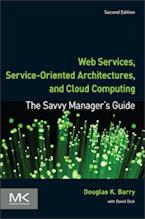
Web Services, Service-Oriented Architectures, and Cloud Computing: The Savvy Manager's Guide (Second Edition)
by Douglas K Barry with David Dick
This is a guide for the savvy manager who wants to capitalize on the wave of change that is occurring with Web Services, service-oriented architecture, and—more recently—Cloud Computing. The changes wrought by these technologies will require both a basic grasp of the technologies and an effective way to deal with how these changes will affect the people who build and use the systems in our organizations. This book covers both issues. Managers at all levels of all organizations must be aware of both the changes that we are now seeing and ways to deal with issues created by those changes.