Posts on the
Design Decomposition Blog
Cloud Users’ View of Security
Two recent surveys (details below) support the driving and restraining forces related to security shown in the Force Field Analysis for Using a Public Cloud instead of an In-House Private Cloud posted a couple weeks ago. Participants in both surveys were Cloud users. Data supporting the driving forces: The TechInsights Report 2013: Cloud Succeeds stated [...]
June 19, 2013
Changes for IT and Regulatory Requirements
This post picks up on two ideas in my last post. The first  idea is that IT will have significant change, in part, from the adoption of Cloud Computing. Take a look at IT Departments Won’t Exist in Five Years at Computerworld.com. It states that: Consumerization of IT and self-service trends will lead to a [...]
June 12, 2013
Using a Public Cloud instead of an In-House Private Cloud
Last April, Jason Bloomberg of ZapThink issued a ZapFlash titled Cloud Computing: Rethinking Control of IT. I thought it would be useful to organize his arguments into a Force Field Analysis as described in Web Services, Service-Oriented Architectures, and Cloud Computing. The following analysis also includes information from two other ZapFlash entries that Jason referenced [...]
June 5, 2013
Five Principles for the Incremental SOA Analysis
After last week’s posting, I thought I should say more about incremental SOA analysis. The following is from Chapter 10 in Web Services, Service-Oriented Architectures, and Cloud Computing. Service-oriented architecture (SOA) projects are no different from other IT projects in that larger projects tend to fail and issues regarding change can scuttle projects. This chapter [...]
May 29, 2013
Incremental SOA and Change
Computerworld had an article last January that discussed American Airlines’ approach to using Web Services and multiple enterprise service buses (ESBs) as part of their service-oriented architecture (SOA). The authors emphasized a change from build vs. buy and from using mainframes. That, however, is not the part I found interesting. (Also, several comments to the [...]
May 22, 2013

A service-oriented architecture is essentially a collection of services. These services communicate with each other. The communication can involve either simple data passing or it could involve two or more services coordinating some activity. Some means of connecting services to each other is needed.

Service-oriented architectures are not a new thing. The first service-oriented architecture for many people in the past was with the use DCOM or Object Request Brokers (ORBs) based on the CORBA specification. For more on DCOM and CORBA, see Prior Service-Oriented Architectures.

Services

If a service-oriented architecture is to be effective, we need a clear understanding of the term service. A service is a function that is well-defined, self-contained, and does not depend on the context or state of other services. See Service.

Connections

The technology of Web Services is the most likely connection technology of service-oriented architectures. The following figure illustrates a basic service-oriented architecture. It shows a service consumer at the right sending a service request message to a service provider at the left. The service provider returns a response message to the service consumer. The request and subsequent response connections are defined in some way that is understandable to both the service consumer and service provider. How those connections are defined is explained in Web Services Explained. A service provider can also be a service consumer.

Service-oriented architecture

>>
Also see Web Services Definition, Web Services Explained, and Service-Oriented Architecture (SOA) and Cloud Computing

Related Articles

More on the general topic: Web Services Articles

Related Online Briefings

Douglas K Barry

Read More Free Articles on This Site

There are over 450 pages of articles on this site with over 130 pages on Web Services and service-oriented architecture.

Search this site for more articles

Custom Search

Browse this site for more articles

Click on the topics below to browse the articles on this site. You can see more detail by clicking on the arrows. This highlights the location of the current article: Service-Oriented Architecture (SOA) Definition.

Loading...

The Savvy Manager's Guide Related to Service-Oriented Architecture

Douglas K Barry has prepared the material on this site. He is also the author of a book that explains Web Services, service-oriented architecture, and Cloud Computing in an easy-to-understand, non-technical manner.
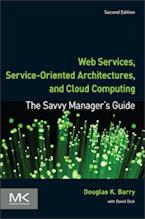
Web Services, Service-Oriented Architectures, and Cloud Computing: The Savvy Manager's Guide

Web Services, Service-Oriented Architectures, and Cloud Computing: The Savvy Manager's Guide (Second Edition)

by with David Dick

This is a guide for the savvy manager who wants to capitalize on the wave of change that is occurring with Web Services, service-oriented architecture, and—more recently—cloud computing. The changes wrought by these technologies will require both a basic grasp of the technologies and an effective way to deal with how these changes will affect the people who build and use the systems in our organizations. This book covers both issues. Managers at all levels of all organizations must be aware of both the changes that we are now seeing and ways to deal with issues created by those changes.

The intent of this book is to give you an opportunity to consider some ideas and advice that just might make it easier for your organization to realize the potential benefits in Web Services, service-oriented architectures, and cloud computing. No crystal ball exists to tell us the services that will be available tomorrow. Undoubtedly, there will many innovative services that we cannot envision at this time. For that reason, this book presents a straightforward approach that will help you get your organization ready to take advantage of a service-oriented architecture—in whatever form it takes.

"Web Services, Service-Oriented Architectures, and Cloud Computing by Douglas Barry provides easy-to-follow guidance around the proper use of web services, how they exist within SOA, and how the emerging use of cloud computing correctly fits into the mix. This is something that most in this industry can neither define nor implement, and getting it right the first time is critical to success. If you're looking to understand the true nature of web services, SOA, and cloud computing—including the underlying details—then you should begin by reading this book."


Author, Founder and CTO of Blue Mountain Labs