Support View
Let's look at the situation where one type code cannot be further decomposed.
In this example, all employees who are not teachers of any kind are classified
as "support." These employees are identified by one type code that is
not further decomposed or divided in any way. One way this can
be determined is by looking
at the programming code. A
second, and probably easier, way to determine if there is only one type code is
to look at the views defined. A view is a virtual table defined on the base
table. In this case, the Support View is defined on the Employee Table. This is
illustrated in the diagram below where  a selection is made on the type of
Support and
a selection is made on the type of
Support and  the columns are displayed.
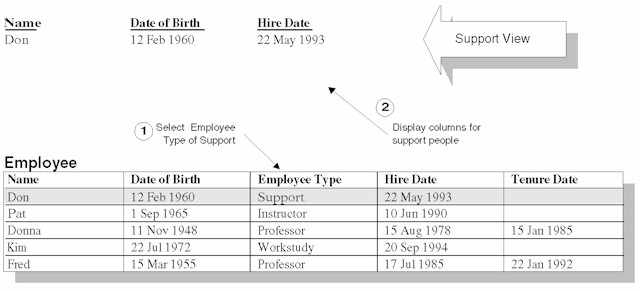
Support Class. Also see the related content below.
Context for Support View
Related Articles for Support View

Author
Douglas K Barry
Principal
You may use this material for your work or classes. Reprint Policy. Be sure to check the menu at the left for other articles available on this site.
The Savvy Manager's Guide
Douglas K Barry is also the author of a book that explains Web Services, service-oriented architecture, and Cloud Computing in an easy-to-understand, non-technical manner.
Web Services, Service-Oriented Architectures, and Cloud Computing: The Savvy Manager's Guide (Second Edition)
by Douglas K Barry with David Dick
This is a guide for the savvy manager who wants to capitalize on the wave of change that is occurring with Web Services, service-oriented architecture, and—more recently—Cloud Computing. The changes wrought by these technologies will require both a basic grasp of the technologies and an effective way to deal with how these changes will affect the people who build and use the systems in our organizations. This book covers both issues. Managers at all levels of all organizations must be aware of both the changes that we are now seeing and ways to deal with issues created by those changes.