You might have seen the recent news reports about the collision between U.S. and Russian communication satellites. The U.S. satellite was one of the Iridium satellites. What wasn’t reported and you probably don’t know is that an object database management system (ODBMS) is an important part of the Iridium system. Even though ODBMSs are a [...]
February 13, 2009
I am now also posting on the Cutter Blog. My initial posting is (The Acronym) SOA is (Perhaps) Dead (at Some Companies); Long Live Services. It is a response to Anne Thomas Manes’ SOA is Dead; Long Live Services on her blog at the Burton Group.
January 9, 2009
The typical definition of an atomic task or process is one that cannot be decomposed further. This is vague and subject to interpretation. The Decomposition Matrix on this site uses a specific definition: A task (for business process diagrams) or a process (for data flow diagrams) is atomic if every input relates to every output [...]
December 3, 2008
My last posting referenced the criteria for a well-formed business process diagram mentioned in Business Process Driven SOA using BPMN and BPEL by Matjaz B. Juric and Kapil Pant. I am going to expand on their criteria to create a more comprehensive definition of a well-formed business process diagram.
To start, here are three criteria from [...]
November 18, 2008
I recently received two new books on business process modeling. Both books looked interesting because they had great titles. As it turns out, one book is great and the other not so good.
The not so good book is Business Process Driven SOA using BPMN and BPEL by Matjaz B. Juric and Kapil Pant. There are [...]
October 9, 2008
The Design Decomposition Blog is written by Doug Barry.
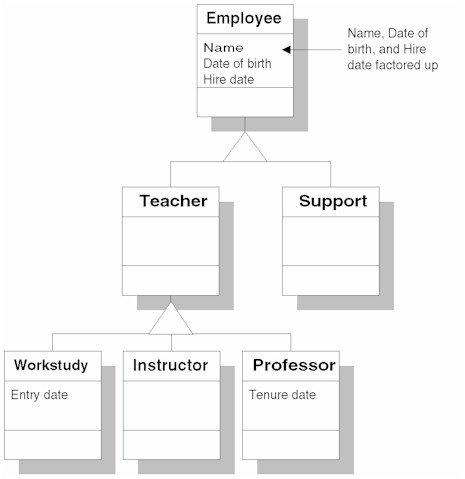
The Teacher View (new
window) and the Employee
View (new window) can be used as hints
for creating intermediate classes above the leaf
classes (new window). Inspection of these
views will provide ways for factoring attributes up higher in the class
hierarchy. The term factoring attributes up refers to moving the
definition of the attributes up as high as possible in the class hierarchy.
Looking at the multi-type views will likely show you which attributes can be
factored up and what name you should assign to the new intermediate classes
above the leaf nodes. The name is usually the same name as the multi-type view
that you are using.
To create the intermediate classes above the leaf classes, simply add the
Teacher and Support Classes above the tentative
classes (new window) and factor up the
common attribute based on the multi-type view. The result is shown below.
There are nearly 400 pages of articles on this site with over 50 pages on object-relational mapping.
Search this site for more articles
Custom Search
Browse this site for more articles
Click on the topics below to browse the articles on this site. You can see more detail by clicking on the arrows. This highlights the location of the current
article: Creating class hierarchy by factoring attributes.
Related recent articles from Google News
Even with its success, .NET causes some consternation SDTimes.com The Entity Framework is a broader object-relational mapping framework for .NET. Microsoft denied that internal politics played a role in its decision to ... 10 Mar 2010 at 8:53am
Browsing Database Artifacts Using Data Source Explorer SYS-CON Media (press release) Generate Object Relational Mappings and Test with EJBQL Oracle Enterprise Pack for Eclipse provides a powerful and flexible object relational mapping ... 4 Mar 2010 at 2:52pm
The Holy Grail of Persistence? SYS-CON Media (press release) At this point, anyone who's been dealing with O/R mapping (like Ted Neward who said: "Object/relational mapping is the Vietnam of Computer Science"), ... 2 Mar 2010 at 5:41am
Java EE 6 & GlassFish v3: Flexible, Extensible, and Simple CIOL For example, Java Persistence API 2.0 defines an API for the management of persistence and object/relational mapping. An RI is a binary distribution and is ... 8 Mar 2010 at 5:21am
A look at ColdFusion 9's new features Builder AU Another huge addition in ColdFusion 9 is the incorporation of the Java Hibernate object-relational mapping (ORM) library. ColdFusion abstracts much of the ... 2 Mar 2010 at 9:41pm
Pro LINQ Object Relational Mapping in C# 2008 by Vijay P. Mehta Average Customer Review: based on 11 reviews. Customer Review: I am not sure what the 2 and 3 star reviews are about, because I thought this book was excellent, and considering the book says "intermediate" I'm not sure why people were expecting a "deep technical ORM, LINQ to SQL, or EF" book. The book is broken into 5 different parts: Part 1 - ORM Concepts - This is really good background for p...
C++ Database Development: Featuring Parody the Persistent Almost-Relational Object Database Management System by Al Stevens Average Customer Review: based on 1 review. Customer Review: Al Stevens, C++ Database Development (MIS Press, 1992) Two questions come to mind as to why anyone would be reading a ten-year-old book on database development in an outdated edition written to cater to an operating system that (almost) no longer exists in any meaningful way. (Or why they would be reading a review of such a book.) Tho...
Foundation for Object / Relational Databases: The Third Manifesto by C. J. Date, Hugh Darwen Average Customer Review: based on 4 reviews. Customer Review: Mr. Data and Mr. Darwen have much to say in this book. The question is will community of "database" people read it, assimilate it, and get to sufficient mass to discuss the merits of the concepts described in this book? And, if that does happen, will it be too late to implement any of the concepts in a real DBMS? There is no question...
Multimedia Databases: An Object-Relational Approach by Lynne Dunckley Average Customer Review: based on 1 review. Customer Review: Bought it used, was supposed to be in perfect condition, but had a little wear and tear here and there. Still in great condition and worth the rebate, shipping was also much fast than what was initially indicated.