Application Server Definition
An application server is a component-based product that resides in the middle-tier of a server centric architecture. It provides middleware services for security and state maintenance, along with data access and persistence.
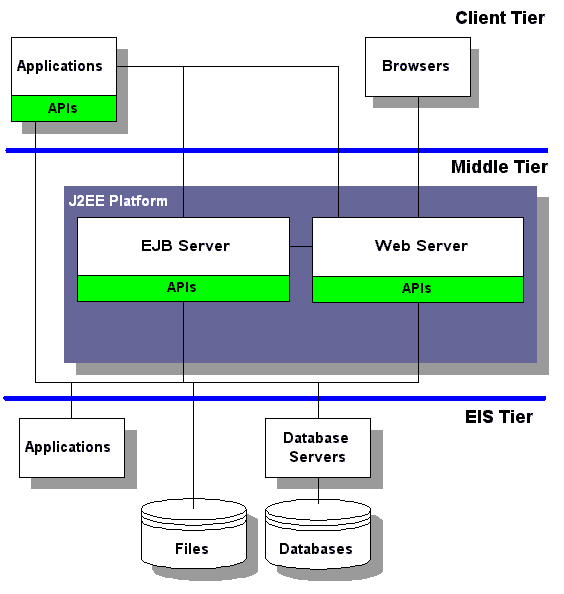
Java application servers are based on the Java™ 2 Platform, Enterprise Edition (J2EE™). J2EE uses a multi-tier distributed model. This model generally includes a Client Tier, a Middle Tier, and an EIS Tier. The Client Tier can be one or more applications or browsers. The J2EE Platform is in the Middle Tier and consists of a Web Server and an EJB Server. (These servers are also called "containers.") There can be additional sub-tiers in the middle tier. The Enterprise Information System (EIS) tier has the existing applications, files, and databases.
For the storage of business data, the J2EE platform requires a database that is accessible through the JDBC, SQLJ, or JDO API. The database may be accessible from web components, enterprise beans, and application client components. The database need not be accessible from applets.
See the related content links below for more information.
Context for Application Server Definition
Articles Providing More Detail
- J2EE Web Server or Container
- J2EE EJB Server or Container
- J2EE Application Program Interfaces (APIs)
Related Articles for Application Server Definition

Author
Douglas K Barry
Principal
You may use this material for your work or classes. Reprint Policy. Be sure to check the menu at the left for other articles available on this site.
The Savvy Manager's Guide
Douglas K Barry is also the author of a book that explains Web Services, service-oriented architecture, and Cloud Computing in an easy-to-understand, non-technical manner.
Web Services, Service-Oriented Architectures, and Cloud Computing: The Savvy Manager's Guide (Second Edition)
by Douglas K Barry with David Dick
This is a guide for the savvy manager who wants to capitalize on the wave of change that is occurring with Web Services, service-oriented architecture, and—more recently—Cloud Computing. The changes wrought by these technologies will require both a basic grasp of the technologies and an effective way to deal with how these changes will affect the people who build and use the systems in our organizations. This book covers both issues. Managers at all levels of all organizations must be aware of both the changes that we are now seeing and ways to deal with issues created by those changes.