Web Services, Service-Oriented Architectures, and Cloud Computing
This site will help you get started with a service-oriented architecture (SOA) using Web Services and Cloud Computing. It features free articles, services, and product listings that can be used to develop a service-oriented architecture using Web Services and Cloud Computing.
- Articles that provide an extensive overview of Cloud Computing, Web Services, standards, and related technologies that can be used in a service-oriented
architecture. There are over 450 pages of free, online articles on
this site. Here are the major categories of articles. Expand the "Articles" menu item at the left for more detail.
- Service-Oriented Architecture Articles
- Cloud Computing Articles
- Database Articles
- Application Server Articles
- Services to help your organization decide how to use a service-oriented architecture.
Example Enterprise Service-Oriented Architecture with Cloud Computing
The following diagram is an example of a service-oriented architecture using Web Services. Click on the yellow boxes below to obtain more information on a subject.

Getting Started
We help prepare organizations for moving to a service-oriented architecture:
- Consulting and customized working sessions on software architecture. This helps you quickly make fully informed decisions concerning your enterprise architecture. More...
- Mentoring on technical issues. These sessions make it easier for managers and project leads to get up-to-speed on architectural considerations. More...
- Speaking on topics related to advanced software architectures and how such architectures can be used in organizations. This is a great way to communicate the value of using various types of software architectures to larger groups. More...
Use of Material
You may use this material on this site for your work or classes. Reprint Policy.
The Savvy Manager's Guide
Douglas K Barry is also the author of a book that explains Web Services, service-oriented architecture, and Cloud Computing in an easy-to-understand, non-technical manner.
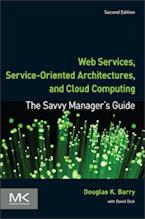
Web Services, Service-Oriented Architectures, and Cloud Computing: The Savvy Manager's Guide (Second Edition)
by Douglas K Barry with David Dick
This is a guide for the savvy manager who wants to capitalize on the wave of change that is occurring with Web Services, service-oriented architecture, and—more recently—Cloud Computing. The changes wrought by these technologies will require both a basic grasp of the technologies and an effective way to deal with how these changes will affect the people who build and use the systems in our organizations. This book covers both issues. Managers at all levels of all organizations must be aware of both the changes that we are now seeing and ways to deal with issues created by those changes.
The intent of this book is to give you an opportunity to consider some ideas and advice that just might make it easier for your organization to realize the potential benefits in Web Services, service-oriented architectures, and Cloud Computing. No crystal ball exists to tell us the services that will be available tomorrow. Undoubtedly, there will many innovative services that we cannot envision at this time. For that reason, this book presents a straightforward approach that will help you get your organization ready to take advantage of a service-oriented architecture—in whatever form it takes.
This is a nontechnical book on a technical subject. It assumes no prior knowledge of the technology. It is written with a high-level view at the beginning of the book. As the book progresses, technical details are introduced and explained.
This book is part of the Savvy Manager's Guide series. The series is intended to help IT managers deal with technological change. Douglas K Barry is also the series editor for the Savvy Manager's Guides.

Author
Douglas K Barry
Principal
Barry & Associates, Inc.